Two Decades Experience
Results Driven
Easy to Understand
No Diva Environment
For over 20 years, Pilates was my language for understanding the body. But I reached a point where selling class packages just didn't cut it for me. My clients were strong in the studio, yet struggling with stress, regulation, and life habits outside of it. I wanted them to have more than good form — I wanted them to have a nervous system that supported real, lasting change.
That’s why I transitioned from teaching Pilates to studying Integrative Medicine between 2022-2025 and ultimately earned my doctorate in Natural Medicine. I wanted a way to help clients not just move better but live better!
Now I return to teaching Pilates as part of a somatic method — a way to regulate the nervous system, unwind old patterns, and strengthen from the inside out. But only after the brain is balanced the the whole body is addressed somatically. You still get an effective, intelligent workout, but it lands deeper and lasts longer because it’s guided by your body’s internal cues, not external pressure or performance. Even if it was just one session, I want you to walk away with lasting changes in your psyche and body.
The result?
More strength, more ease, more awareness, and more sustainable change — both in and out of the studio
Ready to stop the cycle of trying harder and finally work with your body instead of against it?
Explore The Esogetic + Pilates Method -- where we regulate the nervous system, rebuild your inner capacity, and make movement feel safe, sustainable, and deeply your own.
Before we go any further, I want you to understand why movement feels so hard to sustain -- and it has nothing to do with willpower.
Most people think they're "undisciplined," "inconsistent," or "self-sabotaging." But what's actually happening is far more tender and far more human:
Your attachment history is living in your fascia, your midbrain, and your capacity to follow through.
And until those deeper patterns are met, no exercise program -- not even Pilates -- can stick.
This is why I combine Esogetic Medicine with movement: we regulate the roots so your body can finally receive the benefits.
Here are the five ways attachment injuries shape your relationship with movement, motivation, and self-care -- and why your system needs safety before it can create consistency.
5 Ways Attachment Shapes Your Relationship with Movement
- Difficulty Feeling Your Body
- Self-Care feeling Unsafe
- Midbrain Regulation Issues
- Interrupted Follow-Through
- Emotional Overwhelm
Pilates Mentorship
I work with Pilates teachers—both new and seasoned—who are ready to deepen their craft with clarity and confidence.
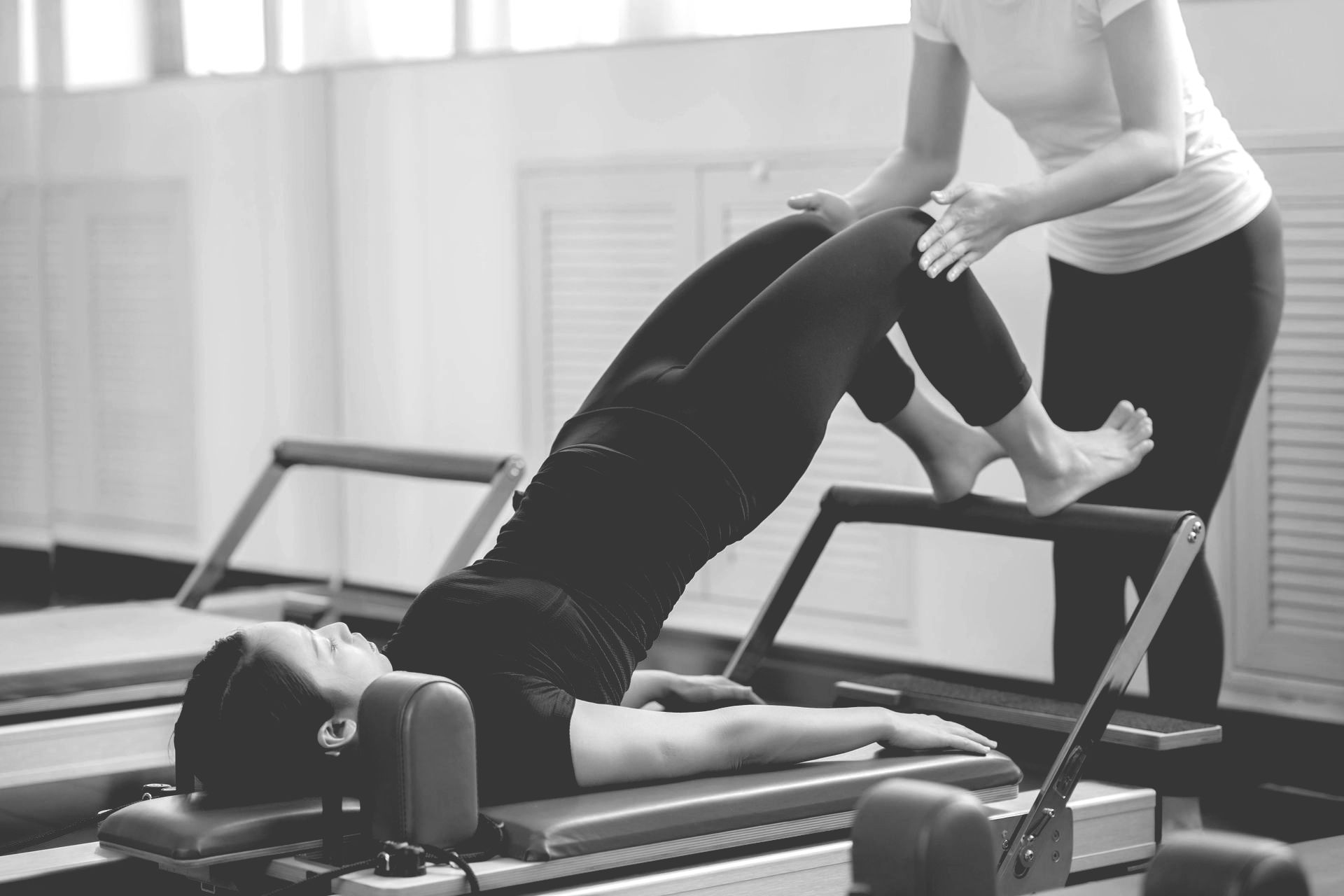
If you’ve ever craved a space where curiosity is encouraged and logic is celebrated, you’re in the right place. In our sessions, questions are welcome, exploration is expected, and understanding why matters just as much as knowing how.
I’ve learned that teaching becomes more powerful when it’s rooted in connection—both to our students and to the integrity of the work. Whether you’re refining your cueing, sharpening your eye, or navigating the subtleties of client relationships, you don’t have to figure it out alone. I am happy to work with wherever you need a little refinement, a dose of clarification, or a jump in confidence.
I am fortunate to be have been mentored on my Pilates path this way, and very fortunately, continue to be.
This is mentorship that honors your voice, your values, and your evolution as a teacher.
Because great teaching isn’t about being perfect—it’s about being present, prepared, and deeply attuned.

New Paragraph
Contact us any time
Contact Us
Extracted from Blog Post of December 3, 2025: Attachment-Injury and Movement Programming
I. Poor Attachment is an early interruption in the brain's development-- a kind of emotional miswiring that forms when a child isn't CONSISTENTLY seen, received or soothed.
Attachment is the first language the nervous system ever learns.
If the environment was chaotic, distant, or emotionally unpredictable, the child's awareness grows OUTWARDS (watching the room, tracking others, and in the modern day-- getting lost in screens) instead of inwards (tracking themselves.)
Later in life, this may show up as:
- difficulty sensing ones own needs
- trouble reading ones internal signals
- repeating painful relationship patterns
- feeling off, unseen, or unworthy without knowing why
This is NOT weakness -- its PHYSIOLOGY.
II. What Poor Attachment Does to the Developing Brain
Early Conflict Becomes the Blueprint: When parents are overwhelmed, inconsistent, or in conflict themselves, the child's brain learns to BRACE. This bracing becomes a long-term pattern that shapes how they relate to others and to themselves.
The Midbrain Takes the Hit: Emotional inconsistency affects the midbrain-- the center for regulation, tone and connection. Tone of voice, facial expression, and emotional presence matter more to a child that words ever could.
Children live from the "Gut Brain": Young children operate from a more instinctive, non-linear place. Without stable attachment, they can get STUCK in early brain states -- like "adult responsibilities" showing up in a little nervous system body.
III. Interrupted Attachment= Interrupted Development
When parents are emotionally absent or unavailable at key times, the child may get frozen in that developmental stage. This may lead to:
- Narcissistic Wounding: Not being seen>> Inflating the self to survive
- Fragmentation: Extreme sensitivity
- Relationship Confusion: Difficulty trusting or staying present
Ages 0-9 are Pivotal: During these years the emotional (limbic) system is their foundation. When injury or inconsistency occurs here, talk therapy alone may not reach the depth of the wound BECAUSE IMPRINT LIVES BENEATH LANGUAGE.
IV. How Poor Attachment Affects Movement and Exercise
A. You can't feel your body clearly: When you grow up tracking others more than yourself, your internal signals get fuzzy and movement can become confusing. In fancy trainer speak, your interoceptive and proprioceptive abilities may become compromised.
B. Self-Care feels unsafe or indulgent: If your early environment taught you to stay small, quiet, or hyper-vigilant, taking time for yourself can feel wrong. For an attachment-injured system, this can trigger old fear.
So you quit before your start. Or your start but cannot sustain. Or you book but don't show up.
(Note to trainers reading this: Another reason to not judge our clients that are still finding their way to commitment success!)
C. The Midbrain's regulation system never finished developing.
Movement IS regulation. This is why people say: "I know what to do (exercise.) But I cannot get myself to di it regularly" IT IS NOT A MINDSET ISSUE-- ITS A REGULATORY GAP!
D. Interrupted Attachment = Interrupted Follow-Through
When key developmental stages were disrupted, the brain learned that fragmentation as a survival tool. Maybe this has something to do with ADHD, but I am not a mental health worker, I digressed and shall not further.
Follow-through requires COHERENCE.
Coherence requires SAFETY.
So maybe your system can start, but can it successfully SUSTAIN?
E. Movement brings up Stored Emotional Patterns: The body remembers everything. Stretching fascia, increasing breath, or engaging dormant
postural muscles can activate old emotional imprints. Without support, a movement program can become uncomfortable -- not because of the exercise, but because the body is surfacing what was once too much to feel. Your system isn't resisting fitness. It's resisting OVERWHELM. Also, the majority of Pilates exercises are belly-up (supine position in trainer speak) which is a highly vulnerable position for mammals.
V. My Pilates + Esogetic Approach, based on Integrative Medicine's top-down approach, fills in the developmental gaps:
- It strengthens the body's ability to feel itself, to come to its own center.
- It resets the midbrain's regulation system
- It restores the inner reward system that makes movement feel good
- It integrates implicit + explicit awareness
- It anchors safety directly into the fascia and nervous system, by treatments that regulate the HPA axis, calm the amygdala and hippocampus, which also is controls coordination.
Once the body feels safe. movement can become a homecoming-- not a threat.
Self care becomes good instinct-- with no guilty after-taste.
Consistency becomes a rhythm-- not a fight.
Movement is NOT medicine if the body is not ready! With its good and valid reasons!
I studied Energy Medicine and Esogetics AFTER two decades of Pilates teaching, so that I can widen the scope and fill the gap that is needed for good changes, joining a few colleagues that have bravely stepped out of the confinements of "movement teaching" to facilitate better success rates through preparing the brain to move.